GastroCafer'e Hoş Geldiniz!



Food is far more than just a biological necessity, it is a mirror reflecting our identity.
When placed in the hands of a skilled director, a simple meal transforms into a sharp instrument for social criticism.
Cinema turns the dinner table into a stage where secrets of class, power, and inequality are laid bare.
As GastroCafer, I invite you to look beyond the recipes and see the message.
In this article, we will explore the films “Parasite, Schindler’s List, Seven Samurai, City of God, Django Unchained, Oldboy, 3 Idiots and There Will Be Blood”.
So, cinephiles and gastronomy lovers, let’s dig in!
Note: Spoilers are inevitable as we analyze the core messages of these films.
Note 2: The images used in this article were generated by AI to reflect the spirit of the films.
1. Parasite (Gisaengchung)

When I watched Bong Joon-ho’s 4-time Oscar winner Parasite, I couldn’t shake the feeling that I had seen this movie before.
The familiarity didn’t come from the plot, but from the stark reality of inequality we witness on the global stage every day.
Naturally, Parasite felt personal.
This film is a masterpiece in showcasing class division, and nowhere is this clearer than in its food.
We see the wealthy Park family feasting on luxury; while the destitute Kim family scrapes by on cheap, boxed pizza in their semi-basement.
Ram-Don: The Gap Between Classes
But the most striking example is the famous “Ram-Don” (Jjapaguri) scene.
When we analyze this dish (a mixture of instant noodles topped with premium Hanwoo beef) we see a collision of two worlds.
This scene forces us to ask a difficult question:
Are we dining at the table or are we surviving on the scraps that fall from it?
Perhaps, much like Ki-woo, many of us are simply living on a daydream.
2. Schindler’s List (1993): Starvation as Identity
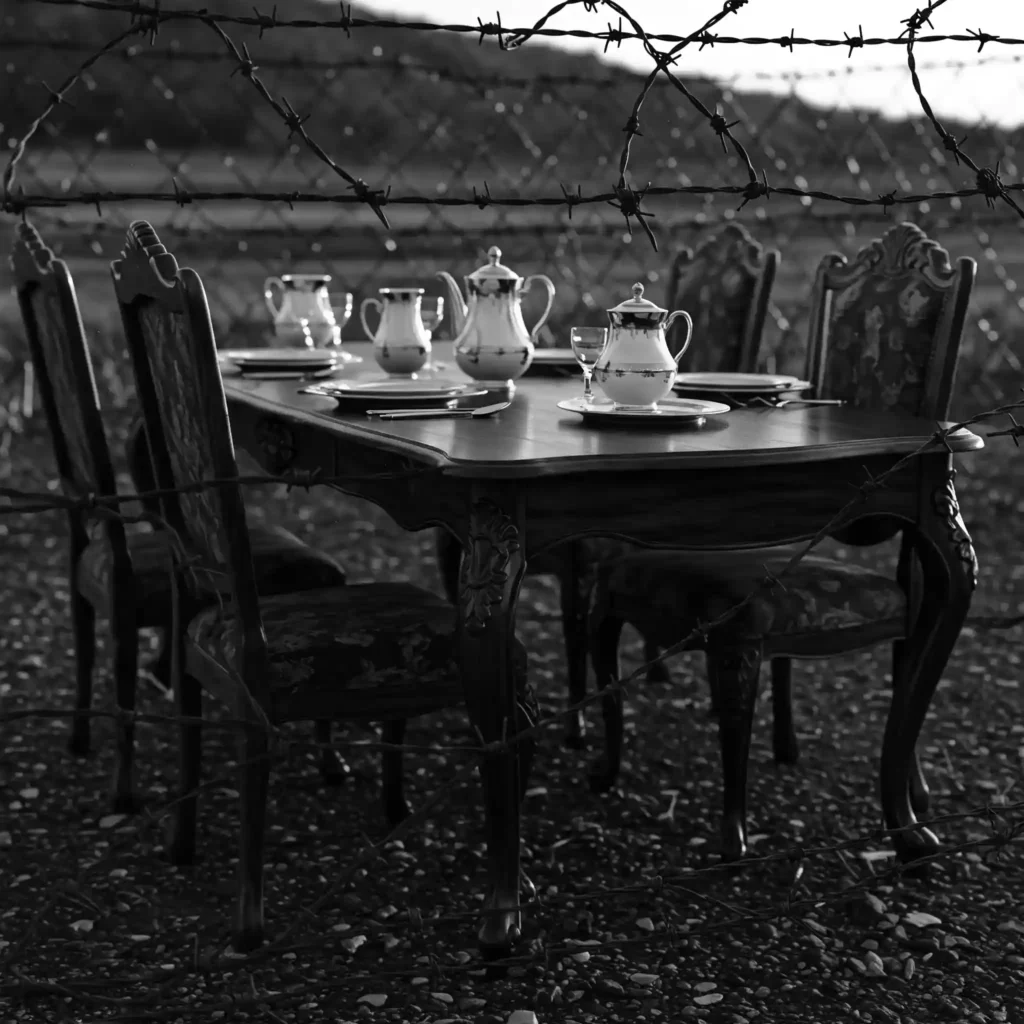
Steven Spielberg’s Schindler’s List is a masterpiece that forces us to confront humanity’s darkest hour.
The black-and-white cinematography makes the suffering of the Jewish people under the Nazi regime even more visceral.
Same country, former neighbors… yet worlds apart.
The Specificity of Famine
The environments inhabited by Oskar Schindler (Liam Neeson) and the Jewish prisoners are studies in absolute contrast.
Throughout the film, Spielberg juxtaposes the humiliation prisoners endure for a mere bowl of watery soup against the Nazis’ indifferent, lavish dinner parties.
A single slice of bread versus a bottle of vintage wine:
In this film, food isn’t just sustenance; it is the defining line of ethnic identity and survival.
3. Seven Samurai (1954)
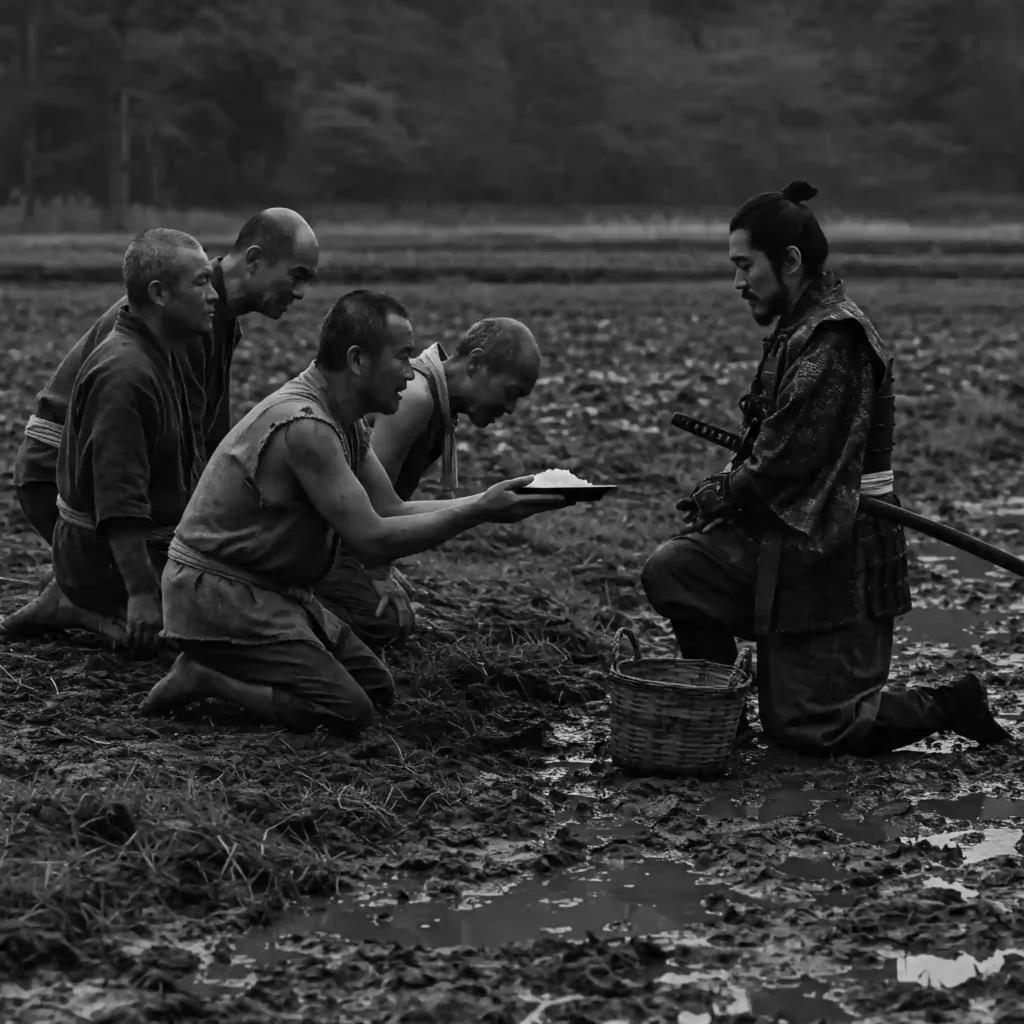
Going back to the classics, Akira Kurosawa’s “Seven Samurai” showed me the desperation of hunger in its purest form.
We focus on the relationship between impoverished villagers stripped of their harvest and the seven samurai they hire for protection.
Interestingly, the bond between these reluctant warriors and the villagers is often quietly shaped around the dinner table.
Food: A Symbol of Both Respect and Shame
The villagers suppress their own hunger by eating millet so they can offer their precious white rice to the samurai.
Samurai paid in rice, villagers eating the lowest of the low…
This is one of the clearest social critiques of the era.
Rice here is not just a nutrient, it is an identity marker.
When you consider the samurai’s losses and the villagers’survival in the finale, the impact of that white rice hits even harder.
This definitely piques your curiosity:
Have you ever considered how a simple grain could determine a people’s honor?
4. City of God (2002): Desire vs. Sustenance

The Brazilian-French co-production City of God (Cidade de Deus) is one of the grittiest films I have ever watched.
In a neighborhood where children grow up holding guns instead of toys, food was never going to be just food.
The violence required to obtain it is one of the most gut-wrenching aspects for the audience.
When Food Becomes Loot
Poverty and societal collapse are extreme in Cidade de Deus.
We see children barely tall enough to reach the counter looting a shop just to get chocolates.
We witness a handful of kids who disregard life, forgetting what they are even fighting for.
The social commentary is stark and undeniable. City of God sends a clear message:
Children’s bellies should be full of warm meals at a family table, not filled with bullets.
5. Django Unchained (2012)
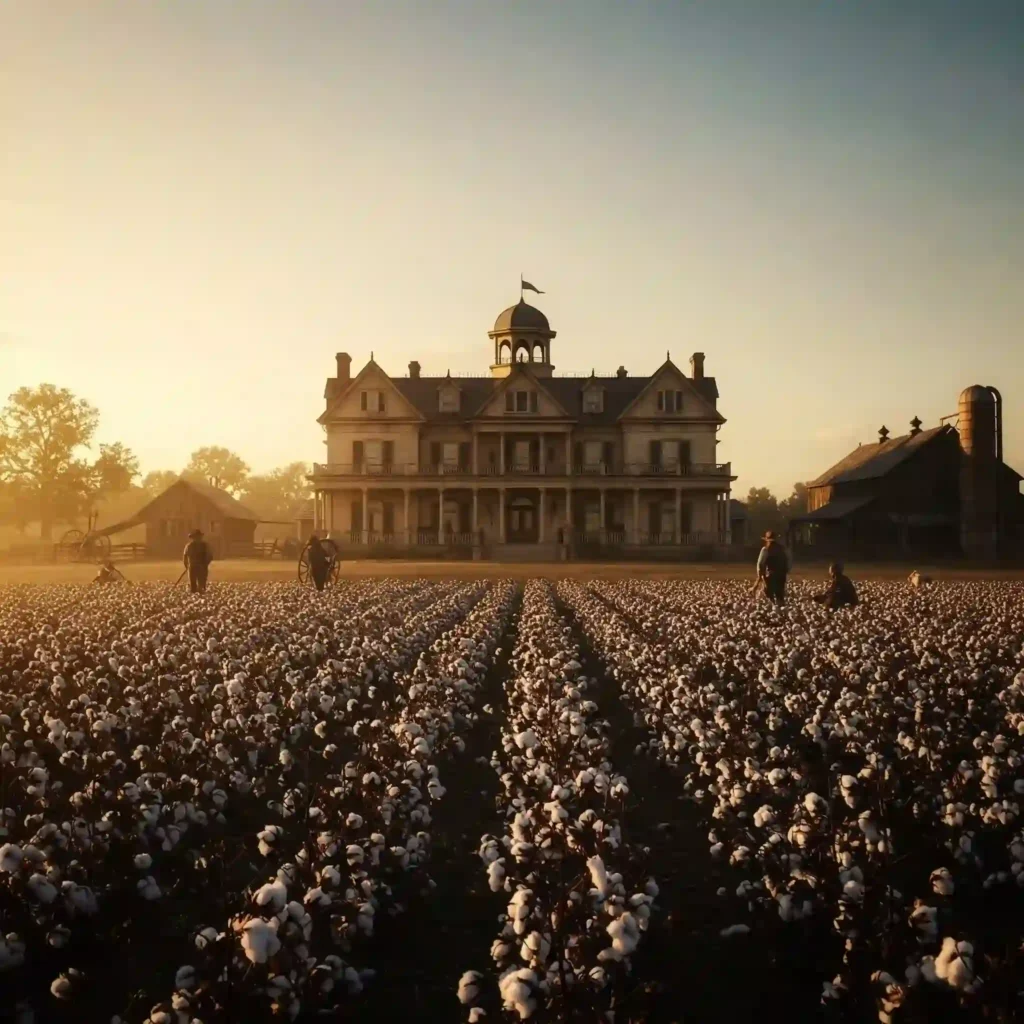
Quentin Tarantino’s Oscar-winning Django Unchained offers many lessons, exposing the era when America accepted white supremacy as the norm.
Through details like the arrangement of dinner tables and Django’s first beer, the film highlights a systemic moral corruption.
A Seat at the Table
When Calvin Candie (Leonardo DiCaprio) orders Stephen to set a place for Django at the dinner table, the residents of “Candyland” are in shock.
The social critique here is sharp:
Until that moment, a slave’s place was to serve the table, not to sit at it.
A black man and a white man breaking bread at the same table was a radical disruption of the era’s “order.”
After watching Django Unchained, we might ask ourselves:
Does true equality begin only when everyone has a seat at the table?
6. Oldboy (2003): Tasting the Past

When I first saw Park Chan-wook’s Oldboy, I was stunned.
While it contains layers of social criticism, I want to focus on a different aspect here:
Food as a cultural element tied to identity, revenge, and memory.
Dumplings: Crumbs of a Lost Life
Our protagonist (Oh Dae-su) is held captive in a room for 15 years, a victim of someone’s revenge.
When he is finally released, the first thing he does to figure out who imprisoned him is to eat Dumplings (Mandu).
He uses the taste to track down the specific restaurant that fed him for 15 years.
This definitely piques your curiosity:
Which flavors seal your memories?
7. 3 Idiots (2009): The Taste of Expectation

Continuing with 3 Idiots, a film featuring Aamir Khan that is quite popular in my country.
While it succeeds as a comedy, labeling it only as a comedy would be an injustice.
The film offers a brilliant critique of the pressure-cooker education system in India.
It exposes a system that makes social mobility nearly impossible and pushes human emotions aside.
Food in the Gap Between Classes
When Rancho and Farhan visit their friend Raju’s house, we see the crushing weight of expectation on Raju’s shoulders.
But what makes the scene memorable is the way the family presents their food:
A gritty, black-white reality check compared to the colorful campus life.
In another pivotal scene, the three friends crash a wealthy wedding just to eat.
This scene alone is packed with messages about class disparity.
Ultimately, blending these heavy themes with a fluid comedic rhythm elevates 3 Idiots to a unique level of social commentary.
8. There Will Be Blood (2007)

Finally, I must mention “There Will Be Blood”, a film that holds a special place in my heart.
It reminded me once again why cinema is such a magnificent art form – though with Daniel Day-Lewis in the lead – that’s hardly a surprise.
Milkshake: Mercy or Malice?
The film’s most famous line “I drink your milkshake!” utilizes a milkshake to explain the mechanics of drainage.
In this scene, Daniel Plainview’s feelings of revenge, greed, and rage are perfectly expressed through a beverage.
Using a simple food item to describe complex oil extraction and the crushing of an enemy is nothing short of brilliant.
If you haven’t seen this masterpiece about the class conflicts revolving around oil, I highly recommend it.
Final Thoughts

In a world where a meal defines status, food is never just a neutral object.
For some, the dinner table is a “safe haven”; for others, it is a “battlefield” of survival.
As GastroCafer, my goal today was simply to offer you a new lens.
Through “Parasite, Schindler’s List, Seven Samurai, City of God, Django Unchained, Oldboy, 3 Idiots, and There Will Be Blood” we uncovered the deep layers of inequality and struggle beneath.
Keep following your gastronomic journey with GastroCafer, and stay healthy!
Next Discovery:
Cafer Can Yeşilyurt
Useful Resources