

Baklava is one of the most iconic and beloved desserts in Turkish cuisine.
With its paper-thin layers of phyllo pastry, and nut-filled interior, it has been enjoyed in its traditional form for centuries.
However, modern culinary creativity allows that even the most classic recipes can be reimagined in entirely new ways.
This was the exact inspiration behind a dessert I developed during a recent culinary class!
My goal was to create an baklava-inspired original fusion dessert using mango chutney, phyllo pastry, tahini, and roasted nuts.
The result was the Mango Chutney Fusion Dessert, a unique recipe that perfectly bridges Turkish and South Asian culinary traditions.
Before we dive into this tropical and syrup-soaked dessert, let’s cover a few culinary basics.
What Is Fusion Cuisine?
Fusion cuisine is a culinary approach that combines ingredients, techniques, or traditions from different cultures on a single plate.
Many chefs use fusion cooking to breathe new life into classic dishes, creating entirely fresh dining experiences.
In this recipe, traditional Turkish baklava meets mango chutney, a condiment commonly associated with South Asian cuisine.
The result is a dessert that blends familiar comforts with bold, unexpected flavors.
What Is Mango Chutney?
Mango chutney is a rich flavored condiment made by slowly simmering mangoes with sugar, vinegar, and a blend of warm spices.
Rooted in South Asian cuisine, it is famous for beautifully balancing sweet, tangy, and spicy notes.
It is commonly served alongside curries, grilled meats, and cheese boards.
In this recipe, we are giving it a completely new role here: The star of a creative dessert filling.
Its fruity sweetness pairs surprisingly well with tahini, roasted nuts, and crisp layers of phyllo pastry.
Alright! Now that we’ve covered the basics, it’s time to start building our Mango Chutney Fusion Dessert.
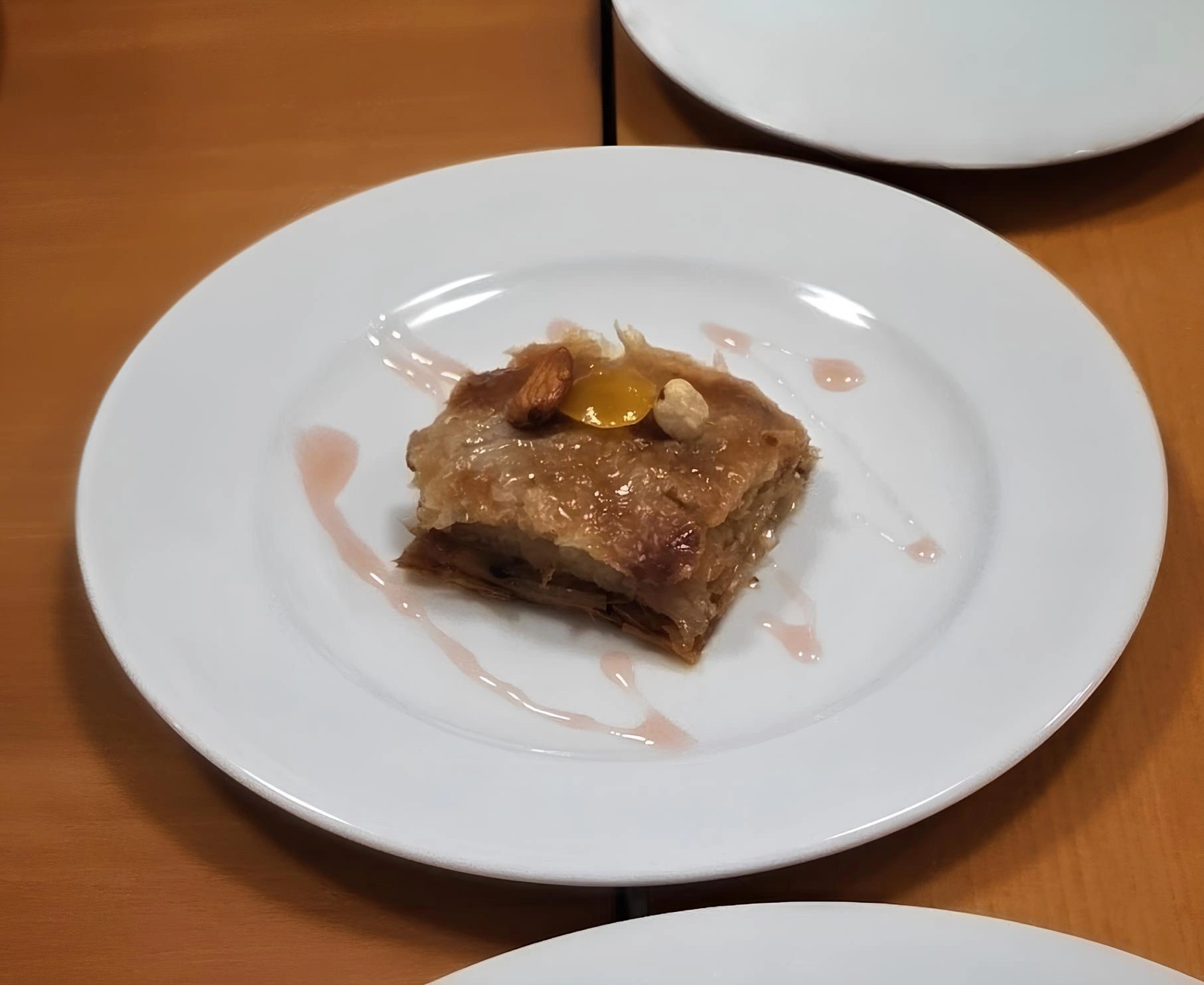
Mango Chutney Fusion Dessert
Ingredients
Method
- Combine the water and sugar in a saucepan and bring to a boil.
- Once the syrup begins to thicken slightly, add a few drops of lemon juice.
- Remove from the heat and allow it to cool completely.
- Place the sugar and water in a small saucepan.
- Once the sugar dissolves and begins to caramelize lightly, add the grated ginger and finely chopped garlic.
- Cook for about 1 minute while stirring.
- Add the mango cubes, apple cider vinegar, salt, black pepper, and red pepper flakes.
- Simmer over low heat for approximately 20 minutes. The mixture does not need to reach a jam-like consistency.
- Remove from the heat and allow it to cool completely.
- Add the tahini, roasted hazelnuts, and sliced almonds to the cooled chutney.
- Process the mixture in a food processor until a thick, spreadable filling forms.
- Spread the filling in a thin layer on a baking tray.
- Bake at 150°C (300°F) for about 10–15 minutes, or until it begins to develop a light golden color.
- The goal is to remove excess moisture from the filling. Allow it to cool completely before use.
- Lightly brush the phyllo sheets with the melted butter and sunflower oil mixture.
- Cut each sheet into 8 equal rectangles.
- Place the first layer down and spread a thin layer of filling over it.
- Add a second layer and repeat the process.
- Finish with a third layer, creating rectangular pastries with three phyllo layers and two filling layers.
- Bake the prepared pastries in a preheated 180°C (355°F) oven until golden brown.
- Once baked, carefully trim the edges for a cleaner presentation.
- Pour the cooled syrup into a wide, deep container. You may not need to use all of the syrup.
- Place the pastries in the syrup and allow them to soak for about 15 minutes.
- Transfer them to a wire rack and let any excess syrup drain away.
- The goal is not to fully saturate the layers, but rather to give the dessert a delicate syrupy character.
- Serve at room temperature.
- For an elegant presentation, garnish with fresh mango cubes, finely ground hazelnuts, or a scoop of vanilla ice cream.
Cafer Can Yeşilyurt